Offloading retail space: How Winnipeg brick-and-mortar stores use off-site commercial storage.
For brick-and-mortar retailers, every square foot of a store needs to serve a purpose. The sales floor needs to display products, customers need room to browse, and employees need space to work efficiently. But as inventory grows, that space can quickly become crowded with excess stock, seasonal merchandise, promotional displays, and incoming shipments.
For many Winnipeg retailers, the solution isn't necessarily to move to a larger storefront. Renting additional retail space can increase overhead, and moving to a bigger location may mean taking on more space than the business actually needs. Instead, some retailers are looking at off-site commercial storage to keep excess inventory accessible without allowing it to take over their stores.
By moving reserve stock and seasonal merchandise into a separate warehouse, retailers can make better use of their existing storefronts while maintaining access to the products they need. With flexible commercial warehouse space available at 700 King Edward Flex Space Warehouse & Storage, Winnipeg businesses can explore a practical way to manage inventory without committing to a larger retail location.
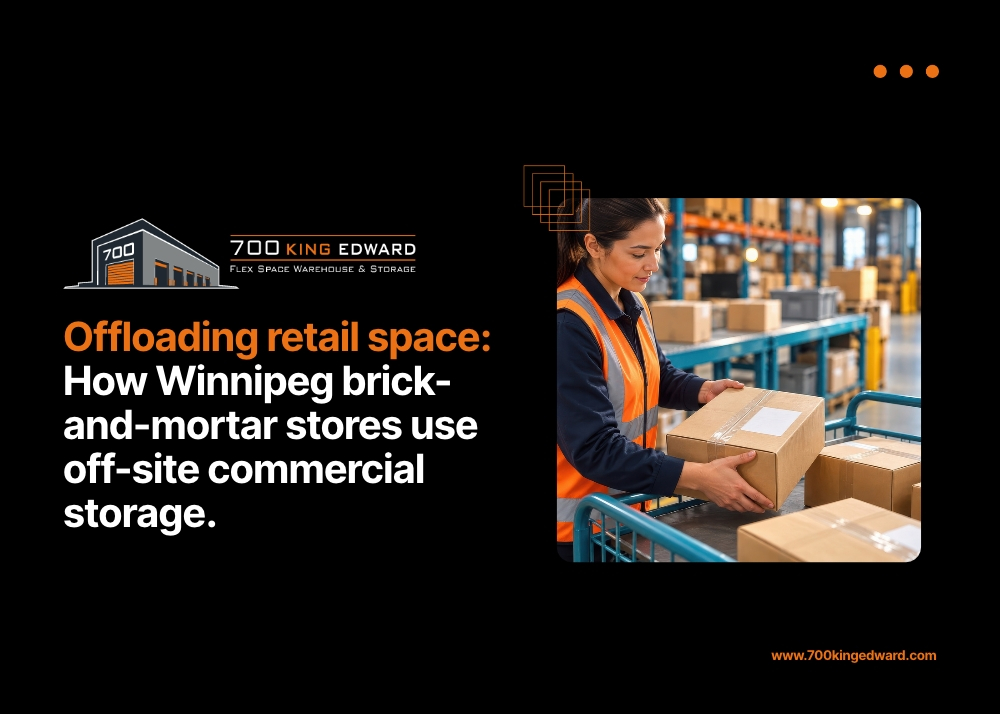
Why retail backrooms become expensive
Retail backrooms often start as small, functional spaces for storing extra products, receiving deliveries, and preparing merchandise for the sales floor. Over time, however, growing inventory can push these areas beyond their original purpose.
Seasonal products may remain in storage for months, bulk purchases can take up valuable room, and additional product lines may require more space than the store can comfortably accommodate. Employees can end up spending more time locating stock, moving boxes, and reorganizing storage areas instead of focusing on customers and daily operations.
The problem extends beyond clutter. When inventory occupies space that could otherwise support sales, product displays, customer movement, or employee activities, the store may become less efficient. A retailer might find that the existing location is large enough for the customer-facing side of the business but too small to accommodate every product held in reserve.
Expanding the storefront isn't always the most practical answer. A larger retail location could introduce additional rent and operating expenses, even if the business only needs more room for inventory. Off-site commercial storage provides another option by separating the space needed for selling products from the space needed to hold them.
How off-site commercial storage helps retailers
Off-site storage gives retailers somewhere to keep excess inventory without filling their storefronts with products that aren't immediately needed. Rather than using every available corner of the backroom, businesses can reserve their on-site space for daily operations and maintain additional stock in a separate warehouse.
This arrangement can be especially useful for retailers that purchase products in bulk, carry seasonal merchandise, or need to maintain a wider inventory than their storefront can comfortably hold. Extra shelving, promotional materials, packaging supplies, and reserve products can be stored off-site and brought into the store as demand requires.
For example, a Winnipeg home goods retailer might need additional space for patio furniture and outdoor accessories ahead of spring and summer. A sporting goods store could require extra capacity before a busy seasonal period, while a clothing retailer may need somewhere to keep merchandise between seasonal transitions. In each case, off-site storage can help preserve a more organized sales floor and backroom.
The key is to choose a storage arrangement that suits the business's inventory levels and replenishment needs. Products that are accessed frequently should be easy to retrieve, while items held for future seasons or occasional promotions may be better suited to longer-term storage.
Reduce storage pressure without expanding your storefront
When a retail business runs out of storage space, moving to a larger storefront can seem like the obvious next step. However, the decision should account for how much additional space is actually needed and what the business would be paying for.
If most of the extra space would be used for inventory rather than customer-facing operations, off-site commercial storage may be a more practical alternative. The retailer can continue operating from its existing location while renting additional warehouse space specifically for stock and supplies.
This can help avoid taking on a larger retail lease simply to accommodate products that don't need to be displayed every day. It can also give the business more flexibility when inventory levels change throughout the year.
The financial benefit depends on the amount of storage required, the lease terms, transportation needs, and how often stock must move between the warehouse and storefront. Retailers should compare the full cost of off-site storage with the cost of expanding, including rent, utilities, staffing, and any additional operational expenses.
At 700 King Edward, businesses can rent warehouse space starting at approximately 1,000 square feet, with larger areas available for growing storage requirements. Flexible leasing options can accommodate temporary storage needs as well as longer-term arrangements, giving retailers an alternative to committing to a larger storefront before they need one.
Manage seasonal inventory more efficiently
Seasonal inventory is one of the biggest challenges for retailers with limited storage space. Products often need to be purchased well before the period when customers are most likely to buy them. Once the season ends, unsold merchandise and remaining supplies can occupy valuable space for months.
Off-site storage allows retailers to separate seasonal stock from the products they need on a regular basis. Instead of filling the backroom with merchandise that won't be sold for several weeks or months, businesses can keep those products in a separate warehouse until they're needed.
This approach can also support businesses preparing for major sales events, holiday shopping periods, product launches, or promotional campaigns. Retailers can arrange additional space ahead of anticipated demand and adjust their storage requirements when inventory levels return to normal.
The ability to rent space for shorter periods is particularly useful when storage needs fluctuate. At 700 King Edward, warehouse arrangements typically start with a 30-day minimum, while weekly arrangements may be available upon request with adjusted pricing. This gives retailers an option for handling temporary inventory increases without automatically committing to a long-term arrangement.
Keep inventory accessible while protecting your products
Moving inventory off-site only works when the storage location supports the way a business operates. Retailers need to consider how products will be delivered, unloaded, organized, retrieved, and transported back to the store.
A warehouse should provide suitable conditions for the products being stored, along with practical loading access and enough room to manage inventory safely. Businesses storing temperature-sensitive merchandise may also need to consider climate control, while retailers handling large or heavy shipments may benefit from forklift services and appropriate loading facilities.
700 King Edward offers a climate-controlled warehouse, five loading docks, six grade-level doors, and on-site forklift services with a driver available when needed. The facility also has security patrols three times daily and 32 indoor and outdoor camera placements.
These features can help retailers evaluate whether the facility fits their inventory and handling requirements. Before storing products, businesses should still confirm that the warehouse conditions, access arrangements, insurance requirements, and any additional service costs are appropriate for the items they plan to keep there.
Choosing the right amount of commercial storage
Retailers don't necessarily need to rent a large warehouse to benefit from off-site storage. The right amount of space depends on how much inventory needs to be moved, how products are packaged, and how much room is required for organized access and handling.
A smaller space may be sufficient for overflow inventory, seasonal displays, packaging supplies, or products awaiting replenishment. Businesses with multiple locations, larger product ranges, or substantial seasonal purchasing may require more room.
It's important to account for more than the number of boxes being stored. Products need to be organized so employees can locate and retrieve them, and the storage layout needs to accommodate movement when inventory arrives or leaves the facility.
Retailers should also consider whether their storage requirements are likely to change. A business preparing for its busiest season may need temporary additional space, while a growing retailer may benefit from a longer-term arrangement that can accommodate increasing stock levels.
700 King Edward offers warehouse spaces ranging from approximately 1,000 to 140,000 square feet. This range gives businesses the opportunity to discuss storage requirements based on their current needs and potential growth, rather than assuming they must lease a fixed amount of space regardless of how their inventory changes.
Why Winnipeg retailers should consider 700 King Edward
For retailers looking for commercial storage in Winnipeg, location and flexibility are important considerations. Off-site inventory needs to remain accessible enough to support store operations, particularly when products must be replenished regularly.
Located at 700 King Edward Street, the facility is close to Winnipeg Richardson International Airport and provides access to major transportation routes, including Route 90, the Perimeter Highway, and the Trans-Canada Highway. This can be useful for retailers receiving shipments from suppliers or coordinating inventory movement across the region.
Beyond its location, 700 King Edward offers flexible warehouse leasing, climate-controlled storage, loading facilities, and forklift services. Businesses can arrange short-term or long-term storage based on their requirements, with space available for retail inventory and other commercial goods.
For retailers that need additional stockroom capacity but don't want to expand their storefront, this provides an opportunity to separate inventory storage from customer-facing operations. Instead of allowing excess stock to crowd the sales floor or backroom, businesses can use their existing retail space more effectively while keeping additional products stored elsewhere.
Make better use of your retail space with off-site storage
Your storefront should support the customer experience, not serve as a warehouse for every product your business owns. When excess inventory begins taking over the backroom, limiting displays, or making daily operations more difficult, it may be time to consider an alternative.
Off-site commercial storage can give Winnipeg retailers more room to operate without requiring an immediate move to a larger storefront. By choosing the right amount of warehouse space and planning how inventory will move between locations, businesses can manage seasonal stock, bulk purchases, and growing product ranges more effectively.
700 King Edward Flex Space Warehouse & Storage offers flexible commercial storage solutions for retailers looking for additional inventory space in Winnipeg. Whether you need temporary room for a seasonal increase or a longer-term solution for ongoing stock management, the team can help you explore your options.
Contact 700 King Edward to discuss your retail inventory storage needs and find a warehouse space that fits your business.
Request a quote or schedule a tour today!

Contact Us
700 King Edward Street
Winnipeg, Manitoba, Canada, R3E 0R9
x 204-775-7799
A info [at] 700KingEdward [dot] com
